

NexGard Plus vs Simparica Trio - Which Is the Best Parasite Preventative for Dogs?
Edward Simmons (Updated: Mar 26, 2026) 14 min read

Are all-in-one parasite preventatives the best option for your dog’s long-term health?
Parasite risk is shaped by more than just the season. Local mosquito exposure, tick habitat, travel, wildlife contact, and year-round temperature patterns can all affect how much protection a dog needs. The American Heartworm Society recommends year-round administration of FDA-approved heartworm preventives, and annual testing remains an important part of confirming that prevention is working as intended.
As more pet parents look for simplified ways to protect dogs from fleas, ticks, heartworms, roundworms, and hookworms, Simparica Trio and NexGard Plus have become two of the most commonly compared monthly prescription chewables.
Key Takeaways
Both products combine three active ingredients in one chew, but their labels are not identical. The most useful comparison points are minimum weight eligibility, active ingredients, tick and Lyme-related claims, hookworm spectrum, flea-tapeworm prevention labeling, safety precautions, chew preference, and your dog’s local parasite risk.
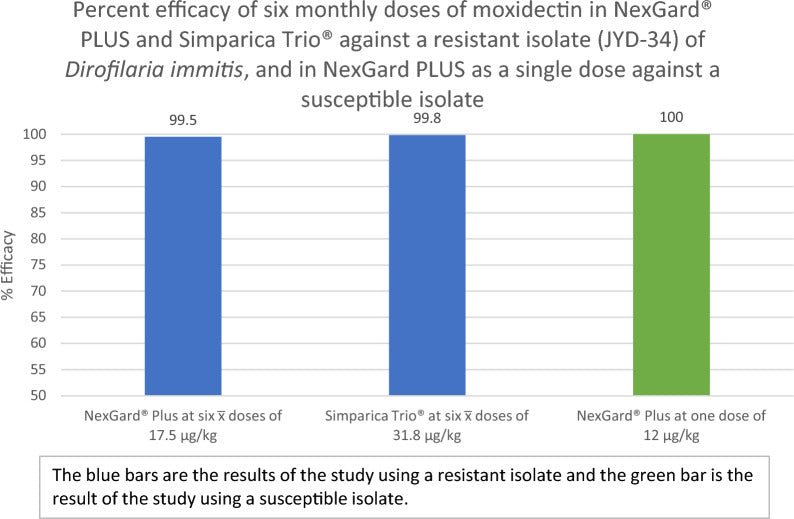
In a 2024 Parasites & Vectors study using the macrocyclic lactone-resistant JYD-34 heartworm isolate, six monthly doses of NexGard Plus and Simparica Trio provided comparable, near-complete prevention, 99.5% and 99.8%, respectively.
In the same study, a single NexGard Plus dose was 100% effective against a susceptible isolate. Simparica Trio also has separate label-supported single-dose efficacy data in controlled heartworm prevention studies. (Source)
Choose between Simparica Trio and NexGard Plus by evaluating your dog’s weight, age, medical history, prior tolerance, breed considerations, travel habits, and local flea, tick, mosquito, and intestinal parasite risks.
[Source]
Simparica Trio vs NexGard Plus: Quick Answer
Simparica Trio may be the better fit for very small dogs because it is labeled for dogs and puppies 8 weeks of age and older weighing 2.8 lbs or more. It also has a label claim for prevention of Dipylidium caninum tapeworm infections as a direct result of killing fleas on the treated dog.
NexGard Plus may be the better fit when broader labeled hookworm coverage is a priority, since its label includes adult hookworm infections caused by Ancylostoma caninum, Ancylostoma braziliense, and Uncinaria stenocephala.
For pet parents comparing dog heartworm prevention and dog flea and tick treatments, both products are strong prescription options. The final choice should come from your veterinarian’s recommendation and your dog’s risk profile.
Simparica Trio vs NexGard Plus Comparison Table
| Feature | Simparica Trio | NexGard Plus |
|---|---|---|
| Product type | Monthly prescription chewable | Monthly prescription chewable |
| Active ingredients | Sarolaner, moxidectin, pyrantel | Afoxolaner, moxidectin, pyrantel |
| Minimum age | 8 weeks and older | 8 weeks and older |
| Minimum weight | 2.8 lbs and greater | 4 lbs and greater |
| Fleas | Yes | Yes |
| Ticks | Yes, multiple tick species | Yes, multiple tick species |
| Heartworm prevention | Yes | Yes |
| Roundworms | Yes | Yes |
| Hookworms | Yes | Yes, with broader labeled adult hookworm species coverage |
| Tapeworm-related claim | Prevention of Dipylidium caninum tapeworm infections as a direct result of killing fleas | No comparable flea-tapeworm prevention label claim |
| Flavor | Liver-flavored chew | Beef-flavored chew |
| Prescription required? | Yes | Yes |
Active Ingredients and Parasite Coverage
Both products use three active ingredients, but they differ in the isoxazoline ingredient used for flea and tick control. Simparica Trio uses sarolaner, while NexGard Plus uses afoxolaner. Both use moxidectin for heartworm prevention and pyrantel for labeled intestinal worm coverage.
What Is NexGard Plus for Dogs?
NexGard Plus is a monthly prescription chewable for dogs that helps protect against fleas, ticks, heartworm disease, roundworms, and hookworms.
How NexGard Plus works:
- Afoxolaner kills fleas and ticks by disrupting parasite nervous system activity.
- Moxidectin helps prevent heartworm disease by targeting immature heartworm larvae before they can develop into adults.
- Pyrantel targets labeled intestinal worms, including roundworms and hookworms.
NexGard Plus has an advantage when broader hookworm labeling matters because it covers adult hookworm infections caused by Ancylostoma caninum, Ancylostoma braziliense, and Uncinaria stenocephala.
What Is Simparica Trio for Dogs?
Simparica Trio is a monthly prescription chewable for dogs that helps protect against fleas, ticks, heartworm disease, roundworms, and hookworms. It also has a flea-tapeworm prevention claim connected to killing fleas on the treated dog.
How Simparica Trio works:
- Sarolaner kills fleas and ticks by disrupting parasite nervous system activity.
- Moxidectin helps prevent heartworm disease by targeting immature heartworm larvae.
- Pyrantel targets labeled intestinal worms, including roundworms and hookworms.
Simparica Trio is labeled for dogs and puppies 8 weeks of age and older weighing 2.8 lbs or greater. It is also indicated for the prevention of Borrelia burgdorferi infections as a direct result of killing Ixodes scapularis vector ticks and for prevention of Dipylidium caninum tapeworm infections as a direct result of killing fleas.
Key Differences Between Simparica Trio and NexGard Plus
1. Minimum Weight Eligibility
Simparica Trio starts at 2.8 lbs, while NexGard Plus starts at 4 lbs. This makes Simparica Trio a more practical option for some toy-breed puppies and very small dogs that are not yet eligible for NexGard Plus.
2. Hookworm Spectrum
NexGard Plus has broader labeled adult hookworm species coverage. This may matter for dogs with higher intestinal parasite exposure, travel risk, kennel exposure, or veterinarian-confirmed hookworm concerns.
3. Tapeworm-Prevention Claim
Simparica Trio has a label claim for prevention of Dipylidium caninum tapeworm infections as a direct result of killing fleas. This is not the same as treating an existing tapeworm infection. If your dog already has visible tapeworm segments or a confirmed tapeworm diagnosis, ask your veterinarian about appropriate treatment.
4. Tick and Lyme-Related Claims
Older comparison articles often frame Gulf Coast tick or Lyme-related protection as a Simparica Trio-only advantage. That wording should be avoided. Current product labels should be checked before making any tick-species claim, because label indications can change. For pet parents, the practical takeaway is that both products are strong flea and tick options, and the best choice depends on the tick species common in your area and your veterinarian’s guidance.
5. Flavor and Monthly Dosing Consistency
Simparica Trio is liver-flavored, while NexGard Plus is beef-flavored. Flavor is not a medical advantage, but it can affect whether a picky dog accepts the chew every month. Because missed doses can create protection gaps, palatability matters in real-world use.
Seasonality, Regional Risk & Long-Term Prevention Strategy
Parasite exposure varies by climate, geography, and season. In warmer regions, fleas, ticks, and mosquitoes may remain active for much of the year. In cooler regions, activity may peak in spring and summer but does not always disappear during colder months.
Both Simparica Trio and NexGard Plus are designed for monthly administration. Consistent dosing is especially important for heartworm prevention because the American Heartworm Society notes that all orally and topically administered macrocyclic lactone preventives are labeled for a 30-day dosing interval, and protection becomes less predictable beyond that window.
What this means for pet parents:
- Year-round prevention is commonly recommended, even outside peak parasite season.
- Annual heartworm testing still matters, even for dogs on prevention.
- Product choice should match local parasite pressure and lifestyle, especially for dogs that hike, travel, spend time in wooded areas, or live in regions with high tick or mosquito exposure.
- Veterinary guidance matters, especially when changing preventatives, managing missed doses, or choosing prevention for dogs with health conditions.
Parasite Resistance and Long-Term Use: Should You Rotate Products?
Routine product rotation is not always necessary. If your dog is doing well on a preventative, receives every dose on schedule, tests negative during routine screening, and has no side effects, your veterinarian may recommend staying with the same product.
Heartworm resistance has been documented in some areas, and local parasite pressure can vary. However, switching between products should not be treated as a do-it-yourself resistance strategy. Both Simparica Trio and NexGard Plus contain moxidectin for heartworm prevention, so changing from one to the other is not the same as switching to a completely different heartworm-prevention approach.
The most important long-term protection steps are consistent dosing, annual heartworm testing, local parasite-risk review, mosquito exposure reduction when appropriate, and veterinary guidance. In high-risk regions, your veterinarian may discuss additional prevention strategies.
Safety and Side Effects
Both NexGard Plus and Simparica Trio are FDA-approved prescription preventatives for dogs. Most dogs tolerate these products well, but side effects can occur. Follow the product label and your veterinarian’s instructions.
Commonly Reported Side Effects
- NexGard Plus: Label-reported adverse reactions may include digestive upset such as vomiting or diarrhea, lethargy, and itching.
- Simparica Trio: Label-reported adverse reactions include vomiting, diarrhea, lethargy, anorexia, increased urination, hyperactivity, and increased thirst.
Both products contain an isoxazoline-class ingredient. The FDA considers isoxazoline products safe and effective for most dogs, but this class has been associated with neurologic adverse reactions, including muscle tremors, ataxia, and seizures. Seizures may occur even in animals without a prior history, so dogs with known neurologic disorders should be discussed with a veterinarian before use.
When to Call Your Veterinarian
Contact your veterinarian if your dog experiences repeated vomiting, diarrhea that does not resolve, unusual lethargy, tremors, stumbling, seizure-like activity, intense itching, facial swelling, appetite changes, or behavior that seems abnormal after dosing.
Puppies, Senior Dogs, and MDR1-Sensitive Breeds
Puppies
Both products are labeled for puppies 8 weeks of age and older, but they differ by minimum weight. Simparica Trio starts at 2.8 lbs, while NexGard Plus starts at 4 lbs. For very small puppies, this weight difference may determine which option is available first.
Senior Dogs
Senior dogs can often use monthly parasite preventatives, but they may need closer veterinary review if they have liver disease, kidney disease, neurologic conditions, chronic digestive issues, or long-term medications. Your veterinarian may recommend baseline testing or closer monitoring before starting or switching products.
MDR1-Sensitive Breeds
Collies, Australian Shepherds, Shetland Sheepdogs, Border Collies, and related breeds may carry MDR1 gene variants that affect how some medications are processed. This does not automatically mean Simparica Trio or NexGard Plus is unsafe at labeled doses, but it does mean breed, genetic status, medication history, and dose accuracy should be reviewed with a veterinarian.
If your dog belongs to a breed commonly associated with MDR1 sensitivity, ask your veterinarian whether MDR1 testing is appropriate before starting any new parasite preventative.
Transition Guide: How to Switch Safely Between Heartworm, Flea & Tick Preventatives
Switching your dog’s parasite prevention plan, whether moving from a combination such as Heartgard plus NexGard or transitioning between Simparica Trio and NexGard Plus, should be done with veterinary guidance to avoid protection gaps or unintended overlap.
1. Consult Your Veterinarian First
- Your veterinarian can review your dog’s medical history, breed considerations, geographic risks, heartworm testing history, and past medication response.
- Your vet can also confirm whether a heartworm test is needed before switching.
- This is especially important if doses have been missed, delayed, vomited, or given inconsistently.
2. Start the New Product When the Next Monthly Dose Is Due
- In most cases, a new monthly preventative is started when the next scheduled monthly dose would normally be due.
- Avoid giving two full monthly preventatives close together unless your veterinarian specifically instructs you to do so.
- If your dog missed a dose, ask your veterinarian or pharmacy team for timing guidance instead of guessing.
3. Monitor After Switching
- After switching to Simparica Trio or NexGard Plus, observe your dog for 24 to 72 hours.
- Watch for vomiting, diarrhea, itching, tremors, stumbling, appetite changes, lethargy, or unusual behavior.
- Report concerning signs to your veterinarian promptly.
4. Consider Heartworm Testing Before Changing Products
- The American Heartworm Society recommends antigen and microfilaria testing before starting or changing heartworm preventives in cases of noncompliance or brand changes.
- Annual testing is also recommended because it helps confirm that prevention is being achieved and maintained.
5. Avoid Self-Medicating or Mixing Products
- Do not combine flea, tick, or heartworm products unless your veterinarian recommends it.
- Do not double-dose after a missed dose unless your veterinarian specifically tells you to.
- Do not use products intended for livestock or other animals in dogs.
Which Product Makes More Sense for Your Dog?
Choose Simparica Trio if your dog is at least 8 weeks old but weighs between 2.8 and 4 lbs, if your veterinarian values its flea-tapeworm prevention label claim for your dog’s risk profile, or if your dog has already tolerated sarolaner-based prevention well.
Choose NexGard Plus if broader labeled hookworm coverage is a priority, if your dog has previously done well with afoxolaner-based products, or if your dog prefers a beef-flavored chew.
For Lyme-related risk, Gulf Coast tick exposure, and other regional parasite concerns, avoid relying on older comparison claims. Ask your veterinarian to match the product to your dog’s current label needs, travel habits, and local parasite pressure.
Buying Strategy: Staying Consistent With Monthly Protection
When you’re giving your dog monthly parasite prevention, how you buy it starts to matter. These are not one-time treatments, so staying stocked helps reduce missed doses.
Once your veterinarian confirms the right product, HardyPaw Autoship can help keep your dog’s monthly prevention on a predictable schedule.
Stay Consistent Without the Hassle
Preventive treatments work best when given regularly. With autoship, the next supply arrives before you run out, which can make it easier to stay on schedule.
Save More Over Time
Autoship savings may add up over the year, especially for multi-dog households or pet parents managing year-round prevention. Check the current HardyPaw offer details before ordering, because promotions may change.
Flexible Enough for Real Life
Your dog’s needs may change as their weight changes or if your veterinarian recommends a different product. Autoship can be adjusted, paused, or canceled as needed.
Final Verdict: Should You Choose Simparica Trio or NexGard Plus?
You are not choosing the best parasite preventative for every dog. You are choosing the best fit for your dog.
Simparica Trio is often the better fit for very small dogs and for pet parents who value its flea-tapeworm prevention label claim. NexGard Plus may be the better fit when broader labeled hookworm coverage matters more or when a dog has already tolerated afoxolaner-based products well.
Both products provide convenient monthly protection against several major canine parasites. Your veterinarian should make the final recommendation based on your dog’s weight, health history, local mosquito and tick exposure, testing history, and medication tolerance.
Simparica Trio vs NexGard Plus FAQs
Q1. Is Simparica Trio safe for dogs with a history of seizures?
Ans: Simparica Trio contains sarolaner, an isoxazoline. The FDA considers isoxazolines safe and effective for most dogs, but this class has been associated with neurologic adverse reactions, including tremors, ataxia, and seizures. Dogs with a history of seizures or other neurologic disorders should be discussed with a veterinarian before use.
Q2. Can I switch my dog from Simparica Trio to NexGard Plus mid-cycle?
Ans: Speak with your veterinarian first. In most cases, the new product is started when the next scheduled monthly dose is due. Avoid overlapping full monthly doses unless specifically directed by your veterinarian.
Q3. Do these medications protect against ear mites or mange?
Ans: Neither product is labeled for ear mites or mange. Some active ingredients in the isoxazoline class may be used off-label by veterinarians for certain mite issues, but you should not use either product for that purpose without veterinary direction.
Q4. How long after giving the chew can my dog swim or bathe?
Ans: Both Simparica Trio and NexGard Plus are oral treatments, so bathing or swimming does not reduce effectiveness the way it can with some topical products.
Q5. Are Simparica Trio or NexGard Plus available without a prescription?
Ans: No. Both are prescription medications. A valid veterinarian prescription helps ensure the correct product, dose, and safety review for your dog.
Q6. Can I cancel or reschedule HardyPaw Autoship?
Ans: Yes. Autoship can be adjusted, paused, or canceled as your dog’s needs change. Review the current HardyPaw Autoship terms before placing an order.
Q7. Should I switch my dog’s parasite preventative every year?
Ans: Not automatically. If your dog is protected, tolerates the product, and your veterinarian is satisfied with testing and risk coverage, there may be no reason to switch. Product changes should be based on medical need, local risk, label fit, or your veterinarian’s recommendation.
Medical References
- Simparica Trio Prescribing Information, Zoetis
- FDA Fact Sheet: Potential Adverse Events Associated with Isoxazoline Flea and Tick Products
- American Heartworm Society Canine Guidelines, 2024
- Preventive efficacy study comparing NexGard Plus and Simparica Trio against heartworm isolates
See Other Comparison Blogs on HardyPaw
Explore more head-to-head comparisons to help you choose the right treatment or product for your dog:
- NexGard Plus vs Heartgard Plus: What’s the Difference?
- Galliprant vs Rimadyl: NSAID Comparison for Joint Pain
- Simparica Trio vs Heartgard Plus: Which Should You Choose?
- Interceptor Plus vs Heartgard Plus: Full Breakdown
- Bravecto vs Simparica: Flea and Tick Treatment Comparison
- Simparica Trio vs Trifexis: Parasite Protection Compared
- Bravecto vs NexGard: Complete Comparison Guide
- Dog Harness vs Collar: Which Is Better for Your Pet?
Related Articles


Recent Articles


