

Simparica Trio vs Trifexis - Which Flea & Heartworm Medicine Is Best?
Edward Simmons 13 min read

Searching for the most effective way to protect your dog from fleas, ticks, and heartworms in 2025?
Choosing the right parasite prevention means more than just picking a brand name – it’s about understanding the full scope of protection, safety, and compatibility with your dog’s health profile. With trusted options like Simparica Trio, Trifexis, NexGard, Interceptor Plus, and Seresto, today’s pet owners face more choices than ever along with greater complexity.
TL;DR - Simparica Trio vs Trifexis
- Key Difference: Simparica Trio includes tick protection; Trifexis does not.
- Parasite Coverage: Both target fleas, heartworms, roundworms, and hookworms. Trifexis also covers whipworms; Simparica Trio covers ticks.
- Action Time: Simparica kills fleas in 4 hours, ticks in 8. Trifexis kills fleas in 30 minutes.
- Price: Simparica Trio costs more but offers broader protection.
- Best Use: Pick Simparica Trio for dogs exposed to ticks; Trifexis for indoor dogs without tick risk.
Among these, Simparica Trio, produced by Zoetis, stands out as a pork-liver–flavored chewable tablet offered in six weight-based dosages suitable for dogs starting at just 2.8 pounds.
Trifexis, developed by Elanco, is available in five beef-flavored tablet sizes, dosed by weight, and is typically administered with food to ensure optimal absorption.
Both medications are prescription-only and combine multiple active ingredients to guard against a broad range of internal and external parasites.
Approximately 1 million U.S. dogs have heartworm, but only 33% are on preventive treatment—this gap puts pets at higher risk as vector-borne diseases in dogs have doubled over the past two decades.
At HardyPaw, we help you cut through the confusion with side-by-side comparisons grounded in veterinary insight and real-world outcomes.
This detailed guide on Simparica Trio vs Trifexis explores parasite coverage, ingredient differences, missed-dose safety, side effects, and more. Whether you're addressing flea infestations, preventing heartworm disease, or protecting against ticks, you’ll gain clear, actionable insight into which treatment best fits your dog’s needs.
So, without further ado, let’s start exploring!!!
How Does Simparica Trio Compare to Trifexis for Flea and Tick Protection?
When comparing Simparica Trio vs Trifexis, the first place to look is the active ingredients - they define what parasites are targeted and how effectively each product works.
What Parasites Do Simparica Trio and Trifexis Protect Against?
- Simparica Trio protects against fleas, five species of ticks (including the Lone Star and deer tick), heartworms, roundworms, and hookworms. It’s considered a broad-spectrum preventative, ideal for dogs at high risk of tick exposure or living in multi-dog households where parasites can spread quickly.
- Trifexis, in contrast, covers fleas, heartworms, roundworms, hookworms, and whipworms—but it does not protect against ticks.
For pet parents in tick-endemic regions, like rural or wooded areas, this missing protection from Trifexis can be a critical drawback.
What Active Ingredients Are in Simparica Trio and Trifexis?
- Simparica Trio ingredients:
- Sarolaner (kills fleas and ticks)
- Moxidectin (heartworm, roundworm, hookworm prevention)
-
Pyrantel (controls hookworms and roundworms)
- Trifexis ingredients:
- Spinosad (kills fleas)
- Milbemycin oxime (targets heartworms and intestinal worms)
These ingredients define each medication’s parasite coverage and mechanism of action.
How Do These Ingredients Kill Fleas, Ticks, and Worms?
- Sarolaner (Simparica Trio) and spinosad (Trifexis) work by disrupting nerve transmission in fleas, causing rapid death. Sarolaner also kills ticks, while spinosad does not.
- Moxidectin and milbemycin oxime are macrocyclic lactones—they block nerve signals in heartworm larvae and intestinal parasites, killing them safely in small doses.
- Pyrantel, found in Simparica Trio, paralyzes roundworms and hookworms so they can be expelled from the body.
Let’s now take a closer look at how Simparica Trio and Trifexis perform in terms of onset of action and duration of protection.
How Effective Is Simparica Trio Compared to Trifexis for Flea, Tick & Heartworm Prevention?
Choosing between these two monthly medications (Simparica Trio and Trifexis) means understanding how well they perform in real-world conditions. Let’s break down their effectiveness in terms of speed, duration, and parasite-specific performance.
Which Flea and Tick Preventative Works Faster—Simparica Trio or Trifexis?
- Simparica Trio begins killing fleas within 4 hours and ticks within 8 hours, thanks to the isoxazoline compound sarolaner.
- Trifexis, using spinosad, starts working against fleas in 30 minutes—but it doesn’t provide tick protection.
Quick Verdict: Trifexis may offer faster flea kill, but Simparica Trio is far more versatile, especially for dogs exposed to ticks.
How Long Does Protection Last With Simparica Trio vs Trifexis?
- Simparica Trio offers up to 35 days of protection, giving some buffer beyond the monthly dose.
- Trifexis provides 30 days of parasite coverage but requires strict monthly compliance.
Quick Verdict: Simparica Trio has a slight edge in duration, making it a better fit for busy pet owners or variable schedules.
Which Is More Effective Overall—Simparica Trio or Trifexis?
- Simparica Trio protects against fleas, ticks, heartworm larvae, and intestinal worms (roundworm, hookworm).
- Trifexis covers fleas, heartworms, roundworms, hookworms, and whipworms—but not ticks.
Overall Verdict: For broad-spectrum parasite control, Simparica Trio is more effective, especially if your dog spends time outdoors or in tick-heavy regions.
While both Simparica Trio and Trifexis are effective in their own right, effectiveness alone isn't the only factor to consider.
Like any medication, these parasite preventatives also have potential side effects - and understanding how they affect different breeds and health conditions is just as important.
Let’s explore what dog owners need to know about the safety profiles of Simparica Trio and Trifexis.
What Are the Side Effects and Safety Concerns of Simparica Trio and Trifexis?
Here’s what you need to know about the side effects, breed-specific warnings, and safety precautions associated with Simparica Trio and Trifexis.
What Are the Common Side Effects of Simparica Trio in Dogs?
Most dogs tolerate Simparica Trio well, but common side effects of Simparica Trio in dogs include:
- Vomiting
- Diarrhea
- Lethargy
- Loss of appetite
Less commonly, dogs may experience tremors, ataxia, or seizures, especially if they have a pre-existing neurological condition.
Note: Simparica Trio contains sarolaner, an isoxazoline-class compound that the FDA has linked to rare neurologic events in sensitive dogs.
What Side Effects Are Reported With Trifexis in Dogs?
Reported Trifexis side effects include:
- Vomiting (most common
- Depression or lethargy
- Decreased appetite
- Pruritus (itching)
Trifexis combines spinosad and milbemycin oxime, which may cause nausea if given on an empty stomach. Always administer with food to minimize discomfort.
Check Safety by Breed, Age, and Health Condition
Is Simparica Trio Safe for All Dog Breeds and Ages?
- Simparica Trio is approved for dogs 8 weeks or older and weighing at least 2.8 pounds.
- Extra caution is advised for collies, Shelties, and other herding breeds with known MDR1 gene mutations, as they may react more strongly to macrocyclic lactones like moxidectin.
Talk to your vet if your dog has a seizure history, chronic illnesses, or is currently on other medications.
Is Trifexis Safe for Puppies and Small Dogs?
- Trifexis is labeled for dogs 8 weeks and older, weighing at least 5 pounds.
- Because of spinosad's stimulant effect, some dogs may exhibit signs of restlessness or hyperactivity shortly after dosing.
For many pet owners, effectiveness and safety are only part of the equation - the final decision often comes down to cost. Let’s break down the price differences between Simparica Trio and Trifexis, and what factors might affect your long-term investment in parasite protection.
Can Simparica Trio or Trifexis Be Used Alongside Other Dog Medications?
For dogs on no other medications, both products are generally safe. But if your dog takes long-term prescriptions for arthritis, epilepsy, or skin conditions, there are interaction risks worth knowing before you dose.
Simparica Trio interactions to flag:
- MDR1 herding breeds (Collies, Shelties, Australian Shepherds): The moxidectin component warrants extra caution in MDR1-positive dogs. Get your dog tested before starting if you haven't already.
- Other macrocyclic lactone products: Do not combine with other drugs from this class — it raises the risk of neurological side effects.
- Anticonvulsants (phenobarbital, potassium bromide): The FDA has flagged the isoxazoline class for rare seizure events. Vet evaluation is required before starting.
Trifexis interactions to flag:
- Ivermectin: Do not combine. Spinosad and ivermectin co-administered can cause tremors and neurological signs, especially in MDR1 breeds. Elanco specifically warns against this combination.
- Anticonvulsants: Dogs on seizure medication should only start Trifexis under direct vet guidance.
- Active heartworm infection: Milbemycin oxime must never be given to a dog that may already have heartworm. A test is required if treatment has lapsed.
Verdict: The most critical warning for Trifexis is the spinosad-ivermectin combination — this is a hard contraindication, not just a precaution. For Simparica Trio, the key concern is moxidectin in MDR1-positive herding breeds.
How Much Does Simparica Trio Cost Compare to Trifexis?
The average monthly cost of Simparica Trio ranges from $36.70 to $42.64, depending on your dog’s size. For Trifexis, the monthly price ranges from $23.28 to $26.81.
Simparica Trio Chews – Pricing by Dog Weight (1-chew/month) (HardyPaw)
- Simparica Trio Chews for Dogs 2.8 – 5.5 lbs - $36.70
- Simparica Trio Chews for Dogs 5.6 – 11.0 lbs - $37.24
- Simparica Trio Chews for Dogs 11.1 – 22.0 lbs - $37.78
- Simparica Trio Chews for Dogs 22.1 – 44.0 lbs - $41.02
- Simparica Trio Chews for Dogs 44.1 – 88.0 lbs - $42.10
- Simparica Trio Chews for Dogs - 88.1 – 132.0 lbs - $42.64
Trifexis Chewable Tablets – Pricing by Dog Weight (1-chew/month)
- Trifexis Chewable Tablets for Dogs 5 – 10 lbs – $23.28
- Trifexis Chewable Tablets for Dogs 10.1 – 20 lbs – $24.49
- Trifexis Chewable Tablets for Dogs 20.1 – 40 lbs – $25.11
- Trifexis Chewable Tablets for Dogs 40.1 – 60 lbs – $26.38
-
Trifexis Chewable Tablets for Dogs 60.1 – 120 lbs – $26.81
[Note: Actual pricing may vary over time. Please check the product page for the most up-to-date pricing information.]
Which Parasite Preventative Offers the Best Value?
- Trifexis is the more budget-friendly option if your dog doesn’t need tick protection.
- Simparica Trio, while more expensive, may eliminate the need for a separate tick preventative, making it a more cost-efficient all-in-one solution for many dog owners.
Pro Tip: Consider the annual cost and the total parasite coverage when choosing between the two, especially if you're managing multiple pets or live in tick-heavy regions.
Price is important, but so is practicality, especially if your dog is picky or sensitive to oral medications.
Knowing how to administer Simparica Trio or Trifexis properly can help ensure your dog stays protected and avoids any unnecessary side effects.
How to Give Simparica Trio or Trifexis Properly?
Giving parasite-prevention medications should be simple but getting it right ensures maximum effectiveness and safety.
Here’s what dog owners need to know about administering Simparica Trio and Trifexis correctly.
Do You Need to Give Simparica Trio With Food?
No, Simparica Trio can be given with or without food. It’s a flavored chewable tablet, and most dogs take it easily as a treat. If your dog tends to be picky, offering it with a small amount of food may help.
Should Trifexis Be Given With Food to Avoid Side Effects?
Yes, Trifexis should always be given with food - preferably a full meal. Administering Trifexis on an empty stomach increases the risk of vomiting, which can reduce its effectiveness. A fatty meal helps with absorption and minimizes side effects.
What Should You Do if Your Dog Vomits the Tablet?
- If your dog spits out Simparica Trio or Trifexis, try hiding it in a soft treat like peanut butter or cheese.
- If vomiting occurs within 1 hour of dosing, contact your veterinarian—your dog may need a repeat dose.
- Never double-dose without professional advice, especially with heartworm preventatives, which can have neurotoxic effects in high doses.
Pro Tip: If your dog regularly refuses oral meds, ask your vet about alternate delivery methods or pairing with food incentives.
What Should You Do if You Miss a Dose of Simparica Trio or Trifexis?
Missing a monthly dose happens to the best of us. The steps you take next depend on which product your dog is on.
If you missed Simparica Trio: Dose immediately and restart your monthly schedule from that date. Simparica Trio offers up to 35 days of protection per dose, so a few days late is unlikely to leave your dog exposed. If more than 35 days have passed in a heartworm-active region, check with your vet before re-dosing.
If you missed Trifexis: Dose immediately and resume monthly from that new date — but never double-dose. If your dog has gone more than 30 days without a dose, your vet may require a heartworm test before restarting. Trifexis contains milbemycin oxime, and giving it to a dog that may have already contracted heartworm can cause serious reactions.
Quick Tip: Always give Trifexis with a full meal, including on a catch-up dose day.
| Simparica Trio | Trifexis | |
|---|---|---|
| Protection window | Up to 35 days | 30 days |
| A few days late | Dose now, reset schedule | Dose now, reset schedule |
| Full cycle missed (30+ days) | Vet check in heartworm regions | Heartworm test required |
| Food required? | No | Yes — full meal only |
Verdict: Simparica Trio's 35-day window gives you more flexibility when a dose runs late. Trifexis requires stricter monthly compliance.
Can You Safely Switch Between Simparica Trio and Trifexis?
Switching from Trifexis to Simparica Trio or vice versa can be safe when done correctly. Always consult your vet before transitioning. To avoid gaps in protection or overdose, time the switch with your dog’s next scheduled dose and ensure there's no overlap in active ingredients.
Understanding the parasite coverage of active coverage active ingredients and the successful transition from Simparica Trio and Trifexis or vice-versa gives you a solid foundation for choosing the right product. However, that’s only part of the equation.
For real-world effectiveness, you also need to know how quickly each medication starts working and how long it continues to protect your dog.
Final Verdict - What’s the Difference Between Simparica Trio and Trifexis?
The main difference between Simparica Trio and Trifexis is tick protection.
Simparica Trio protects against fleas, heartworms, roundworms, hookworms, and five species of ticks. Trifexis covers fleas, heartworms, roundworms, hookworms, and whipworms—but does not protect against ticks. Choose Simparica Trio if your dog is exposed to ticks. Choose Trifexis for tick-free environments and whipworm coverage.
Simparica Trio vs. Trifexis - Quick Comparison Table
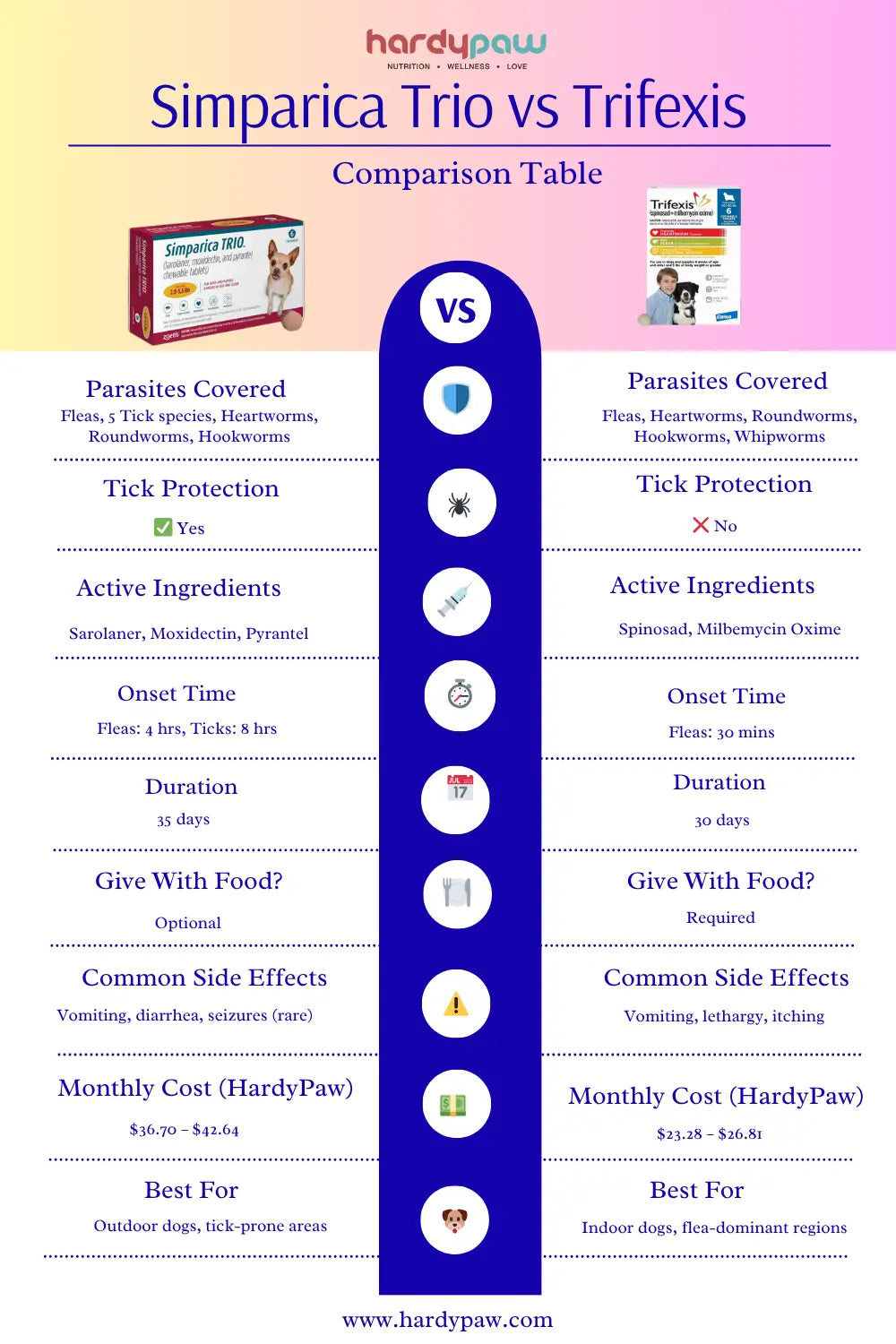
Choose Simparica Trio if you want comprehensive, all-in-one protection including ticks. Go with Trifexis if you're looking for cost-effective flea and heartworm prevention and don’t need tick coverage.
Simparica Trio or Trifexis - Which Product Should You Choose?
Both Simparica Trio and Trifexis offer strong protection against common canine parasites, but the right choice depends on your dog’s lifestyle, health history, and exposure risk.
Simparica Trio is ideal for dogs who spend time outdoors or in tick-heavy areas, while Trifexis is a good fit for indoor dogs or those sensitive to isoxazolines.
Protect Your Dog with the Right Choice Today
Still unsure which option fits your pup best?
Explore our full range of vet-approved dog flea tick medicines and heartworm treatments at HardyPaw, and get the protection your dog deserves—delivered to your door, with trusted support every step of the way.
Simparica Trio vs. Trifexis FAQs
Can Simparica Trio and Trifexis be given together?
No, combining Simparica Trio and Trifexis is not recommended; both contain heartworm preventatives and could cause overdose or toxicity if used concurrently.
Is Simparica Trio safe for pregnant or lactating dogs?
Simparica Trio has not been evaluated in pregnant, breeding, or lactating dogs; consult your veterinarian before use in reproductive situations.
Can I switch from Trifexis to Simparica Trio mid-cycle?
Yes, switching is possible with veterinary approval; ensure no overlap in doses and time the transition to maintain parasite coverage.
Does Simparica Trio protect against whipworms like Trifexis?
No, Simparica Trio does not protect against whipworms; only Trifexis includes coverage for whipworm infestations.
Can Simparica Trio be used year-round or just seasonally?
Simparica Trio should be administered year-round to prevent heartworm infection and ensure continuous flea and tick control.
Is Simparica Trio safe for dogs on Carprofen or other NSAIDs?
There is no known interaction between Simparica Trio and NSAIDs like Carprofen or Meloxicam. The same applies to Trifexis. That said, always inform your vet about every medication your dog is on before starting a new preventative, as individual health conditions can change the risk profile.
What happens if my dog reacts to Simparica Trio or Trifexis?
Discontinue use and contact your vet immediately; reactions may require antihistamines or corticosteroids depending on severity.
How do I store Simparica Trio or Trifexis properly?
Store both medications at room temperature in a dry place, away from direct sunlight, to maintain potency and shelf life.
Can I give Simparica Trio or Trifexis early if I know I'll miss a dose later?
You can give Simparica Trio a few days early without issue, as its 35-day protection window gives some flexibility. Trifexis, however, should be given as close to the 30-day mark as possible. When in doubt, ask your vet before adjusting the schedule.
See Other Comparison Blogs on HardyPaw
Explore more head-to-head comparisons to help you choose the right treatment or product for your dog:
- Simparica Trio vs NexGard Plus: Comparison Guide
- NexGard Plus vs Heartgard Plus: What’s the Difference?
- Galliprant vs Rimadyl: NSAID Comparison for Joint Pain
- Simparica Trio vs Heartgard Plus: Which Should You Choose?
- Interceptor Plus vs Heartgard Plus: Full Breakdown
- Bravecto vs Simparica: Flea and Tick Treatment Comparison
- Bravecto vs NexGard: Complete Comparison Guide
- Dog Harness vs Collar: Which Is Better for Your Pet?
Related Articles


Recent Articles